The Scottish Thistle: Purple, Powerful and Proud
It can’t have escaped the notice of many that the Scottish thistle is the national flower of Scotland. But do you know how it came to be so? In this article we delve into the history of this stubborn and beautiful plant and why it is such an important symbol of our heritage. We also look at how to recognise it, where to find it, and cover a few everyday uses that you may never have thought of before…
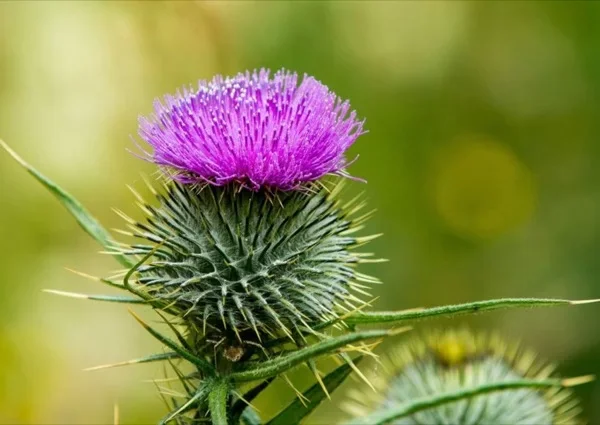
Latin name: Onopordum Acanthium
Common name: Scottish Thistle or Cotton Thistle
Scotland’s National Flower
The thistle has been the national emblem of Scotland since the reign of King Alexander III (1249–1286) and is the oldest recorded ‘national flower’. It has become so well-know and is so easily recognised that it is probably one of the first things to pop into the minds of most when thinking of Scotland- well of course alongside a few other matters of national pride, like the Scottish Kilt, the Highland Cow, and of course the delicacy that is Haggis!
The Scottish thistle, named a resilient weed by some, claimed bold and beautiful by others, has always featured across the landscape of Scotland. And whilst nobody quite knows for certain what reason it was chosen as a national Scottish emblem, there are a number of historic legend that allude to it’s origin (discussed in more detail further down!)
History and Legends of the Scottish Thistle
The most commonly heard legend about the Scottish thistle occurred during the 13th century. The soldiers of the Norse king, Haakon, are said to have planned a surprise invasion at Largs in Western Scotland. The Viking force had planned to creep up on the Scottish clansmen and highlanders whilst they slept and use stealth to overcome them. Part of their plan to make as little noise as possible on their approach was ultimately their undoing- they went barefoot!
Unfortunately for the invaders, one of the soldiers had the misfortune of standing down- hard!- on a thistle. His resulting cry of shock and of pain was enough to rouse the sleeping Scotsmen and alert them to the impending attack. The Scots leapt to their feet, charged into battle and were ultimately victorious, and all thanks to the Scottish thistle. If this story is in fact true, it’s no wonder they immediately chose the plant as the Scottish emblem.
(Many believe that this specific incident happened at the 1263 Battle of Largs, which marked the beginning of the departure of King Haakon IV of Norway who, having control of the Northern Isles and Hebrides, had harried the coast of the Kingdom of Scotland for some years. But there are also other versions of a similar story in circulation, from alleged different dates and different locations. Such is the beauty and mystery of legends as they are told and retold from generation to generation I suppose!)
Another legendary tale tells of the Romans, during their conquering of the British Isles. Apparently when on the way up north, they decided to stop two thirds of the way through their original planned route and built Hadrian’s wall. They declared anything north of it to be inhospitable and undesirable and left Scotland untouched. Apparently the fact that they wore sandals to battle had a lot to do with it, and rather than marching on fields full of thistle, they decided to hold back on their plans.
The Scottish thistle in Popular Culture
‘Flower of Scotland’ is considered the unofficial national anthem of Scotland, and it was named after the national flower, the Scottish thistle. It can be heard sang as a matter of national pride at many sporting event and on other occasions. You can read the lyrics in full HERE.
The Scottish thistle is responsible for Hugh MacDiarmid’s famous long poem ‘A Drunk Man Looks at the Thistle‘, one of the major modernist literary works of the 20th century. In this poem, a drunk man lies on a moonlit hillside looking at a thistle, jaggy and beautiful, which epitomises Scotland’s divided self. The man reflects on the fate of the nation, the human condition in general and his own personal fears. You can read an excerpt from it HERE.
The thistle also represents one of the highest honours Scotland can give an individual. The Most Ancient and Most Noble Order of the Thistle is an order of chivalry which was founded by James VII and II in 1687, and which is bestowed to those who have made an outstanding contribution to the life of Scotland and the greater United Kingdom.
In 1503, the poem entitled ‘The Thrissil and The Rois’ (‘The Thistle and The Rose’) penned by the Scottish poet William Dunbar, was believed to have been inspired by the marriage of King James IV of Scotland to Princess Margaret Tudor of England. The thistle represented King James and the rose represented Princess Margaret.
The thistle features in the name of many Scottish football clubs, most well known is Partick Thistle Football Club, but there are many others that play in lower level leagues too.
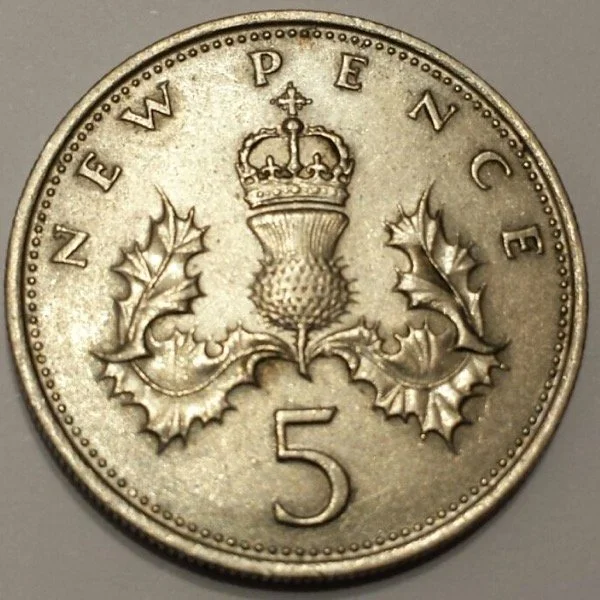
The Scottish thistle appears on a number of coins. The first were silver coins issued by King James III in 1474, then the thistle also starred on the bawbee, which was a Scottish sixpence that was introduced in 1538, and there have been many more since then, up to and including the British pound coin.
These days the Scottish thistle is seen on a huge variety of touristy merchandise, from sporrans and jewellery to soap and tea-towels, and so much more.

Habitat of the Scottish Thistle
The Scottish thistle prefers and thrives in habitats where the summers are dry, such as the Mediterranean region, although clearly dry summers are not a prerequisite as it’s abundant in soggy Scotland!
It also grows best in sandy clay and calcareous soils which are rich in ammonium salts. You will most commonly see it in dry pastures, disturbed fields and other sites, natural areas, roadsides, fields, and especially sites with fertile soils such as agricultural areas, range/grasslands, riparian zones, scrub/shrublands valleys and plains.
It is the temperature and moisture, rather than soil nutrient concentrations, that determine the ecological performance and successful growth of the Scottish thistle.
Reproduction of the Scottish Thistle
The Scottish thistle reproduces only by seeds. Most of the seeds germinate in the autumn shortly after the first rains, but with favourable moisture and temperature conditions, some seeds can germinate all year round. When the seeds germinate earlier than the Autumn, this usually biennial plant will appear to behave as an annual.
Impressively, buried seed can remain viable in the soil seed bank for at least seven years, and possibly even for up to twenty years or more! Yearly seed production and seed dormancy are quite widely variable depending on the environmental conditions.
The slender and smooth achenes produced (which each contain a single Scottish thistle seed) are about 3 mm long and are brown with grey markings, and have a slender bristled tip. The most common method of local dispersion is via the wind, but wider dispersions also occur due to humans, birds, wildlife, livestock or streams.
The seeds are sensitive to light and only germinate when close to the surface. Seedlings will emerge from soil depths up to 4.5 cm, but with a shallower depth being more optimal. While some seeds will germinate in the dark, studies indicate that most germination occurs with alternating light/dark cycles, with 8 hours being the optimal day length.
Plants can produce anything from 70 to over 300 flower heads, which can each produce 100 to 200 seeds- therefore, a single plant can produce an incredible 8,400 to 40,000 seeds!
F.A.Q
-
No! The Scottish thistle may be Scotland national flower but it is native to many countries across Europe and Asia. It has also been introduced at mid-latitudes across much of North America.
-
Yes! Try this for an example: The plant was first seen in Utah in 1963. By 1981, it covered approximately 6070 hectares in 17 counties. Eight years later, it had spread to cover more than 22,540 hectares in 22 counties!
-
Believe it or not, yes you can! And in a multitude of ways. The young leaves can be soaked over night in salt and then cooked The stems can be peeled and then steamed or boiled, or eaten raw if harvested before the plant flowers. The tap roots can be eaten both raw or cooked. The dried flowers can be used as an effective rennet substitute for curdling milk. And the seeds are occasionally eaten roasted. If you’ve tried any parts of the plant yourself, we’d love to hear your thoughts and recipes!
-
Again, yes! A concentrated liquor made from boiling the roots has previously been used as a poultice on sore jaws, and a hot infusion of the whole plant has been used as a herbal steam for treating rheumatic joints. A decoction of the whole plant has been used both internally and externally to treat bleeding piles. It may not be a common practise anymore, but we’ve heard strong claims that it did really work!
Plus, in medieval times they thought it could return hair to bald heads and in the early modern period it had been believed to be a remedy for headaches, plague, canker sores, vertigo, and jaundice. We cannot vouch for any of these claims though!
-
Some do, but not many. Whilst thistles are normally avoided by most stock, you will occasionally find un-fussy horses grazing on the flowers or hardy goats that will eat the whole plant. It certainly wouldn’t be the first choice for sustenance for any mammals, but hummingbirds will feed on the flowers of the biennial species.
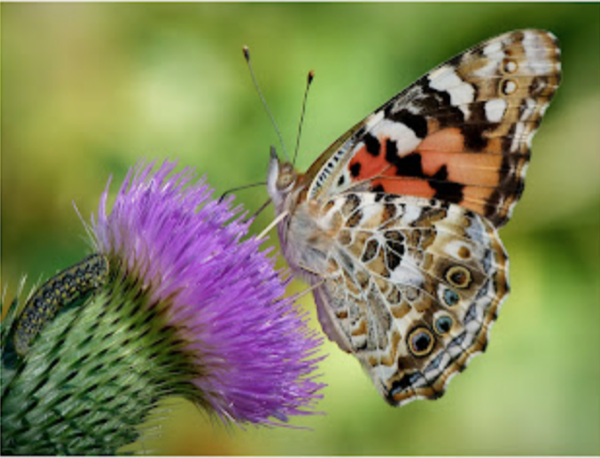
And the thistle flowers are the favourite nectar sources for a number of butterflies, including fritillaries, monarchs and skippers, and the leaves of the Scottish thistle provide food for the caterpillars of some Lepidoptera, such as the thistle ermine.